In northeastern Ethiopia, the Danakil Depression contains landscapes that look remarkably different from most places on Earth.
Bright yellow mineral deposits surround pools of intensely acidic water. Vast salt flats stretch across the desert, while volcanic activity reveals the geological forces operating beneath the region.
The depression forms part of the larger Afar region, where the African and Arabian tectonic systems are slowly pulling apart.
Its extraordinary appearance is not the result of one unusual geological feature. Several extreme natural processes occur close together, creating one of Africa's most distinctive environments.
Here are ten scientifically documented reasons the Danakil Depression resembles an alien landscape.
1. Parts of It Lie More Than 100 Metres Below Sea Level
The Danakil Depression contains some of Africa's lowest land elevations.
Parts of the basin descend to approximately 125 metres below sea level.
This unusual geography results from tectonic stretching and subsidence over millions of years.
Despite its low elevation, the depression is separated from the Red Sea by surrounding land and geological structures.
Its position contributes to the region's unusual combination of intense heat, salt deposits and arid terrain.
2. Dallol Contains Brilliantly Coloured Hydrothermal Pools

Credit: © Pascal Boegli
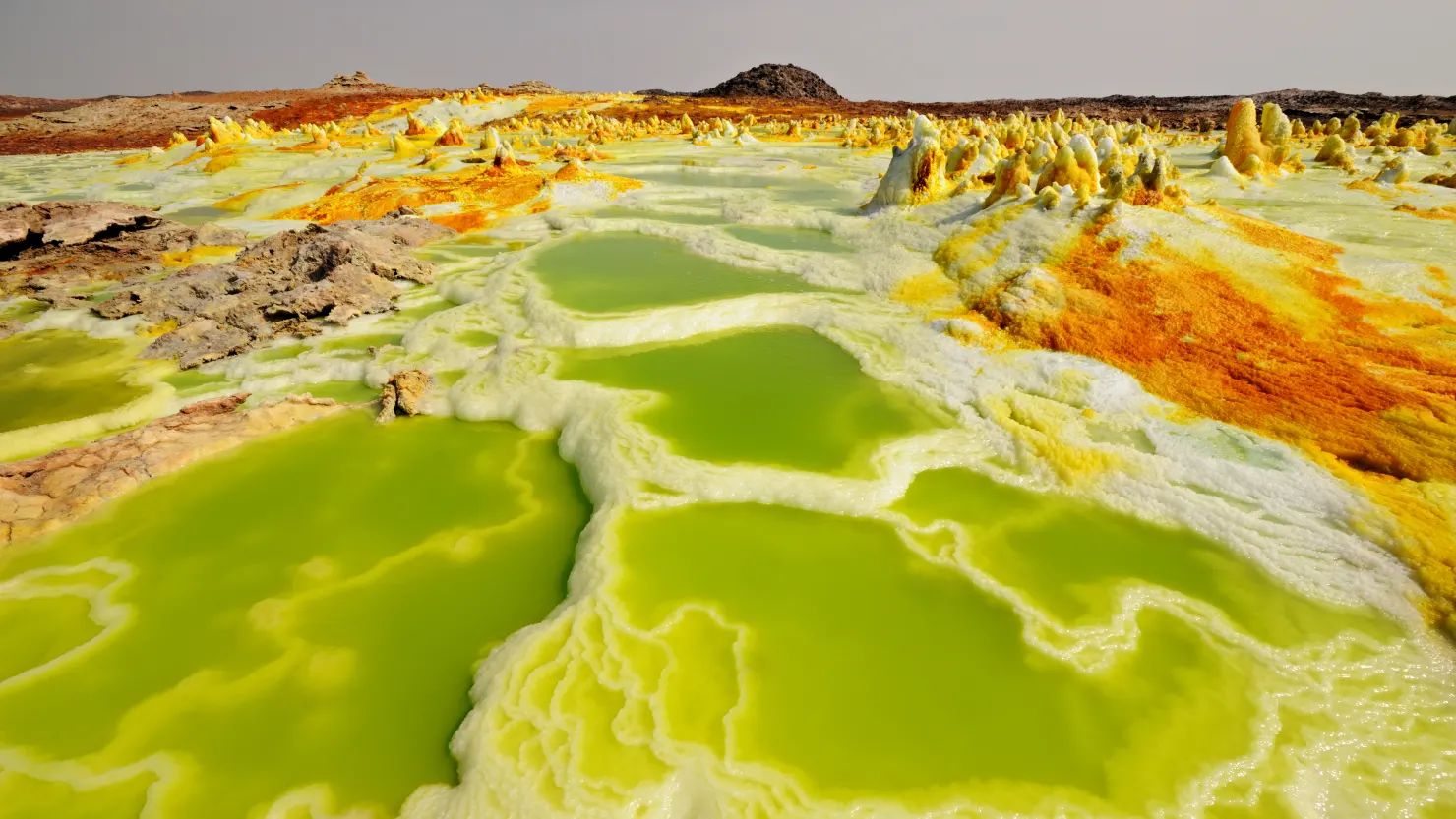
Dallol is famous for its vivid yellow, orange, green and white mineral formations.
The colours are produced by complex chemical processes involving dissolved minerals, iron compounds, salts and hydrothermal fluids.
As mineral-rich water reaches the surface and evaporates, it leaves behind unusual deposits.
The resulting formations resemble landscapes imagined in science-fiction films, yet they are entirely natural.
Scientific studies have examined Dallol as an exceptional example of extreme hydrothermal chemistry.
3. Some Natural Pools Are Extremely Acidic
Dallol contains some of the most acidic natural hydrothermal environments studied on Earth.
Researchers have reported waters with pH values around zero and, in some cases, below zero.
Such extreme acidity is possible in highly concentrated chemical solutions.
These conditions are far outside the range tolerated by most familiar forms of life.
The acidity also makes the environment scientifically important for understanding the chemical limits of biological activity.
4. The Region Is Among the Hottest Places on Earth
Dallol has one of the highest historically recorded average annual air temperatures.
Measurements from the 1960s indicate an annual mean of approximately 34–35°C.
That figure represents an average across the year, not the maximum daytime temperature.
Temperatures during particularly hot periods can rise much higher.
The combination of heat, low rainfall and exposed salt surfaces contributes to the region's exceptionally harsh environment.
5. Three Tectonic Plates Are Pulling Apart Nearby
The Afar region lies near a major tectonic junction involving the Nubian, Somali and Arabian plates.
These plates are moving apart over geological time.
The process stretches and fractures Earth's crust, creating faults, volcanic systems and subsiding basins.
Scientists study the region because it provides an opportunity to observe processes associated with continental breakup.
Over millions of years, continued rifting could substantially change the geography of northeastern Africa.
6. Erta Ale Is One of Africa's Remarkable Active Volcanoes

Ert’ale lava lake (Copyright: Olivier Grunewald).
Erta Ale is an active shield volcano in the Afar region.
It is especially famous for its history of persistent lava-lake activity.
A lava lake forms when molten rock remains exposed within a volcanic crater, although its appearance and activity can change over time.
Erta Ale's volcanic activity demonstrates that the Danakil region is part of an active geological system.
Its dark volcanic rocks contrast sharply with the bright mineral deposits found around Dallol.
7. Vast Salt Flats Cover Parts of the Landscape
The Danakil region contains extensive salt plains, including the Assale area.
These deposits formed through geological processes involving ancient marine waters and evaporation.
As water disappeared, large quantities of salt and other evaporite minerals remained.
In some areas, the landscape appears almost entirely white.
The salt formations record major environmental changes that occurred long before the present desert developed.
8. The Depression Was Once Connected to Marine Environments
The Danakil Basin has experienced episodes of marine flooding during its geological history.
Water entering from the Red Sea contributed to the formation of thick evaporite deposits.
As the water evaporated, layers of salt and other minerals accumulated.
Some of these deposits are exceptionally thick, providing evidence of repeated geological and environmental changes.
The present desert therefore contains geological records of ancient marine conditions.
9. Scientists Study Dallol to Understand the Limits of Life
Dallol has attracted researchers interested in extremophiles, microorganisms associated with unusually harsh environments.
Its combination of high temperature, extreme acidity and concentrated salts makes it particularly important.
Scientific investigations have reached different conclusions about microbial evidence in particular pools and mineral deposits.
Some studies have reported possible microorganisms, while others have found that certain extremely acidic and saline waters may be uninhabitable.
The distinction matters because mineral structures can sometimes resemble biological forms.
Dallol helps scientists investigate how to recognise life under extreme conditions, including when studying other planets.
10. The Afar People Have a Long History in the Region
Despite its severe environment, the Danakil region is not an empty landscape without human history.
The Afar people have lived across parts of northeastern Ethiopia, Eritrea and Djibouti for generations.
Pastoralism, regional trade and traditional salt extraction are important parts of their history.
Salt has been cut into blocks and transported through established trading networks.
This human history provides an important contrast to the region's apparently otherworldly appearance.
What Makes the Danakil Depression So Unusual?
The Danakil Depression brings together several rare environmental conditions in one region: below-sea-level terrain, active tectonic stretching, volcanic activity, extreme heat, highly acidic hydrothermal systems and extensive salt deposits.
Its comparison to another planet is descriptive rather than a scientific ranking. No recognised international index identifies the world's most alien-looking landscapes.
Nevertheless, Dallol's chemistry and the surrounding Afar geology are genuinely studied as analogues for extreme environments that may exist elsewhere in the solar system.
The landscape's extraordinary appearance is the visible result of geological processes that continue to reshape northeastern Africa.