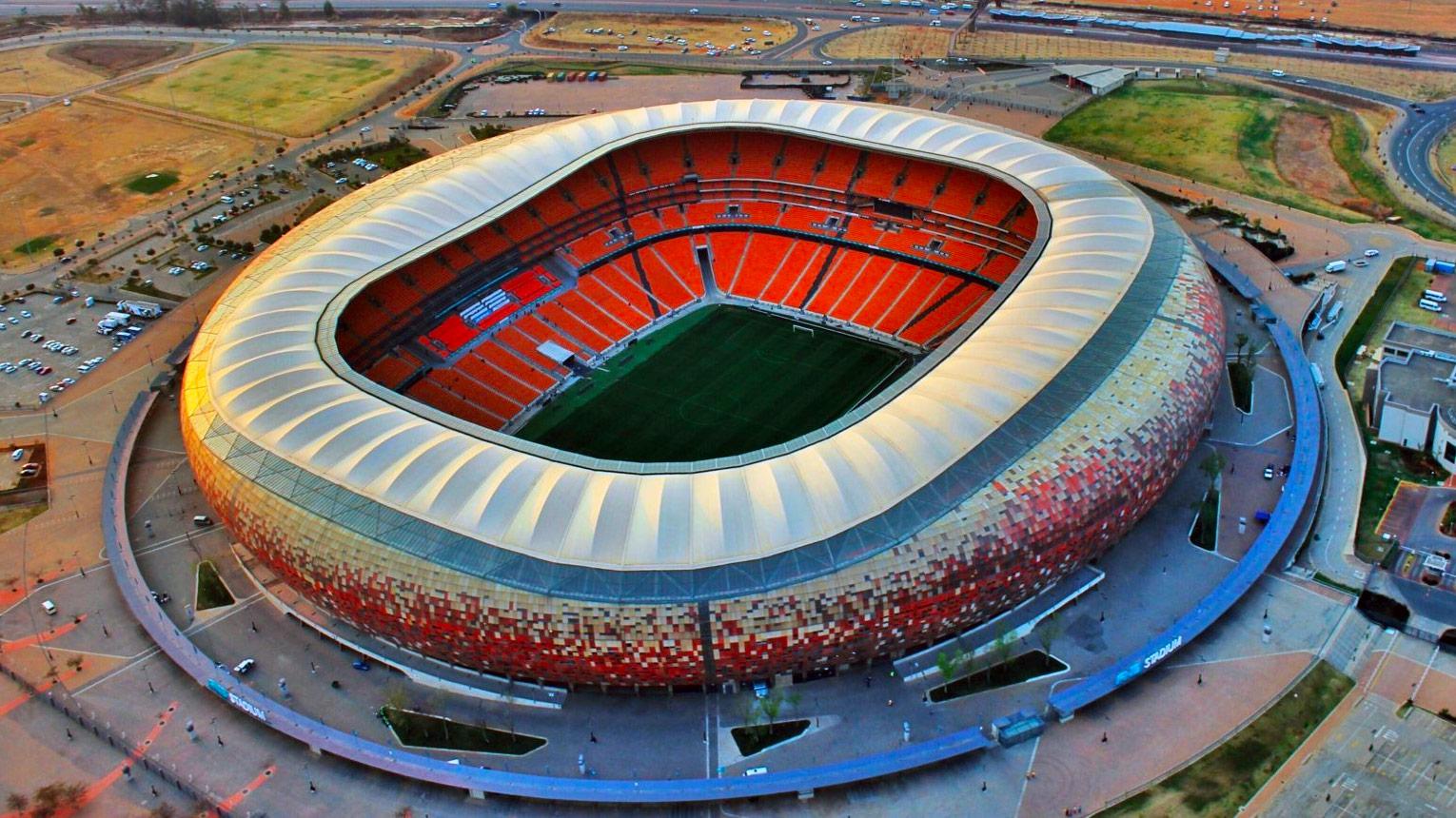
Africa has some of the world's largest football stadiums, with several capable of accommodating more than 60,000 spectators. These venues have hosted FIFA World Cup matches, Africa Cup of Nations finals, continental club competitions and major international fixtures.
The continent's stadium infrastructure continues to expand, with new projects such as Kenya's Talanta Stadium joining established venues in Egypt, Morocco, South Africa and other countries.
Here are 15 of Africa's most notable football stadiums, selected for their capacity, architecture, football history and major international events.
1. FNB Stadium – Johannesburg, South Africa
Capacity: 94,736 spectators

image credit: austadiums.com
FNB Stadium, also known as Soccer City, is one of Africa's largest football stadiums. Located near Soweto, it underwent extensive reconstruction ahead of the 2010 FIFA World Cup.
The stadium's exterior resembles a traditional African calabash. It hosted the opening match and the final of the 2010 World Cup, when Spain defeated the Netherlands 1–0 through Andrés Iniesta's extra-time goal.
It is also a major venue for South African national-team matches and Kaizer Chiefs fixtures.
2. Misr Stadium – New Administrative Capital, Egypt
Capacity: approximately 93,940 spectators

image credit: dostor.org
Misr Stadium opened in 2024 as part of Egypt's Olympic City development in the New Administrative Capital, east of Cairo.
The stadium is among Africa's largest modern sporting venues, with facilities designed to accommodate major football matches and international competitions.
Its construction forms part of Egypt's wider development of sporting facilities outside central Cairo.
3. Borg El Arab Stadium – Alexandria, Egypt
Capacity: approximately 86,000 spectators

image credit: betway.co.za
Borg El Arab Stadium opened in 2009 near Alexandria and is one of Egypt's largest football venues.
On 8 October 2017, the stadium hosted Egypt's decisive World Cup qualifier against Congo. Mohamed Salah scored twice, including a late penalty, as Egypt won 2–1 and qualified for the 2018 FIFA World Cup.
The stadium regularly hosts Egyptian national-team matches and major domestic football fixtures.
4. Stade des Martyrs – Kinshasa, DR Congo
Capacity: approximately 80,000 spectators

image credit: unicosport.cd
Stade des Martyrs de la Pentecôte opened in Kinshasa in 1994.
The stadium hosts Democratic Republic of the Congo national-team fixtures and domestic matches involving leading Congolese clubs.
Its name commemorates four political figures executed in 1966 during Mobutu Sese Seko's rule. The stadium has also hosted major public and religious gatherings.
5. Ibn Batouta Stadium – Tangier, Morocco
Capacity: approximately 75,000 spectators

image credit: sport.le360.ma
Ibn Batouta Stadium, also known as the Grand Stade de Tanger, opened in 2011.
Named after the Moroccan traveller Ibn Battuta, the stadium has undergone major renovations and expansion to accommodate international competitions.
It has hosted Moroccan national-team matches, domestic football and FIFA Club World Cup fixtures. Tangier was also selected as a host city for the 2025 Africa Cup of Nations.
6. Cairo International Stadium – Cairo, Egypt
Capacity: approximately 75,000 spectators

image credit: algomhor.com
Opened in 1960, Cairo International Stadium is among Africa's most historic football venues.
It has hosted Africa Cup of Nations matches, FIFA World Cup qualifiers and major domestic fixtures involving Al Ahly and Zamalek.
In 2019, the stadium hosted the Africa Cup of Nations final, where Algeria defeated Senegal 1–0 to claim the continental title.
7. Stade 5 Juillet 1962 – Algiers, Algeria
Capacity: approximately 64,000 spectators

image credit: outravelandtour.com
Stade 5 Juillet 1962 opened in Algiers in 1972 and takes its name from Algeria's independence date.
The stadium has hosted national-team matches, domestic cup finals and continental club fixtures.
It is closely associated with MC Alger and has undergone renovations over the years, including improvements to its seating and sporting facilities.
8. Talanta Stadium – Nairobi, Kenya
Planned capacity: 60,000 spectators

image credit: nairobileo.co.ke
Talanta Stadium, officially the Raila Amolo Odinga International Stadium, is a major football stadium project under construction in Nairobi.
Construction began in March 2024. The football-specific venue features a roofed spectator area, modern seating arrangements, training facilities and supporting infrastructure.
In October 2026, Kenyan parliamentary inspections reported that construction was approximately 94% complete, with officials targeting readiness by December 2026.
The stadium is being prepared to host matches during the 2027 Africa Cup of Nations, which Kenya will co-host with Uganda and Tanzania. It has not yet established the tournament history of the older venues on this list.
9. Benjamin Mkapa Stadium – Dar es Salaam, Tanzania
Capacity: approximately 60,000 spectators

image credit: en.wikipedia.org
Benjamin Mkapa Stadium opened in 2007 and is Tanzania's principal football venue.
Located in Dar es Salaam, it hosts Tanzania national-team matches and major domestic fixtures involving Simba SC and Young Africans SC.
The stadium is particularly associated with the Dar es Salaam derby between the two clubs. It was also among the venues used for the 2024 African Nations Championship, played in 2025.
10. Olembe Stadium – Yaoundé, Cameroon
Capacity: approximately 60,000 spectators

image credit: magil.com
Olembe Stadium, officially known as Stade Omnisport Paul Biya, opened in 2021 in Yaoundé.
It was a major venue for the 2021 Africa Cup of Nations, held in early 2022. The stadium hosted the final on 6 February 2022, when Senegal defeated Egypt on penalties to win its first AFCON title.
The stadium forms part of a larger sporting complex developed for international competitions.
11. Alassane Ouattara Stadium – Abidjan, Côte d'Ivoire
Capacity: approximately 60,000 spectators

image credit: stadiumdb.com
Alassane Ouattara Stadium, located in Ebimpé near Abidjan, opened in 2023.
It hosted the final of the 2023 Africa Cup of Nations, played on 11 February 2024.
Côte d'Ivoire defeated Nigeria 2–1 in that final, winning the continental championship on home soil.
The stadium is one of the largest modern football venues in West Africa.
12. Stade Olympique de Radès – Radès, Tunisia
Capacity: approximately 60,000 spectators

image credit: arriyadiyah.com
Stade Olympique de Radès opened in 2001 near Tunis.
It hosted the 2004 Africa Cup of Nations final, when Tunisia defeated Morocco 2–1 to win its first continental title.
The venue has also hosted Tunisia national-team matches and major club fixtures involving Espérance de Tunis.
13. Moses Mabhida Stadium – Durban, South Africa
Capacity: approximately 55,000 spectators

image credit: flyairlink.com
Moses Mabhida Stadium opened in 2009 ahead of the 2010 FIFA World Cup.
Its distinctive architectural feature is a large arch extending above the stadium roof. The venue hosted seven matches during the 2010 World Cup, including Germany's 3–2 victory over Uruguay in the third-place playoff.
The stadium also accommodates rugby, concerts and other major events.
14. Moi International Sports Centre Kasarani – Nairobi, Kenya
Capacity: approximately 55,000 spectators

image credit: the-star.co.ke
Moi International Sports Centre, commonly known as Kasarani Stadium, opened in 1987 ahead of the All-Africa Games.
Located in Nairobi, it has hosted Kenya national-team matches, regional tournaments and major athletics competitions.
The stadium underwent renovations ahead of the 2024 African Nations Championship, which Kenya co-hosted in 2025.
It remains one of Kenya's established national sporting venues.
15. Mandela National Stadium – Kampala, Uganda
Capacity: approximately 45,000 spectators

image credit: pulsesports.ug
Mandela National Stadium, commonly called Namboole Stadium, opened in 1997.
Located in Bweyogerere, east of Kampala, it has served as Uganda's principal football stadium and hosted Uganda Cranes international fixtures.
The stadium underwent renovation ahead of the 2024 African Nations Championship, played in 2025, which Uganda co-hosted with Kenya and Tanzania.
It is also among the venues associated with Uganda's preparations for the 2027 Africa Cup of Nations.