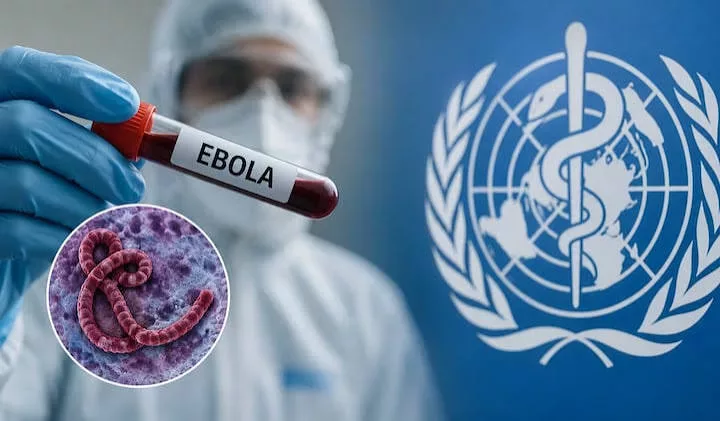
Ebola is one of the deadliest infectious diseases to have caused major outbreaks in Africa. Since the virus was first identified in 1976, outbreaks have occurred in several countries, with some resulting in thousands of deaths.
The largest recorded Ebola outbreak occurred in West Africa between 2014 and 2016, primarily affecting Guinea, Liberia and Sierra Leone. The Democratic Republic of the Congo has experienced the greatest number of separate Ebola outbreaks.
What Is Ebola?
Ebola virus disease (EVD) is a serious illness caused by certain viruses in the genus Orthoebolavirus. The disease was first recognised in 1976 during outbreaks in what are now the Democratic Republic of the Congo and South Sudan.
Ebola can cause fever, severe weakness, muscle pain, vomiting and diarrhoea. Some patients develop bleeding complications, although bleeding does not occur in every case.
The virus spreads through direct contact with infected blood or other bodily fluids, contaminated materials, or infected animals. It is not spread through ordinary airborne transmission like measles.
According to the World Health Organization, the average fatality rate across past Ebola outbreaks has been approximately 50%, although rates have varied considerably. Vaccines and treatments are available for Ebola disease caused by the Zaire ebolavirus.
African Countries Most Affected by Ebola
Historical reported cases and deaths from major Ebola outbreaks. Figures include suspected, probable and confirmed cases where indicated and are not all directly comparable.
1. Sierra Leone
2014–2016 outbreak: 14,124 reported cases and 3,956 deaths
Sierra Leone recorded the highest number of cases during the 2014–2016 West African Ebola epidemic.
The virus spread through communities and healthcare facilities, with major outbreaks affecting districts including Kailahun, Kenema and the capital, Freetown.
The epidemic placed enormous pressure on the country's healthcare system. Sierra Leone was declared free of Ebola transmission in November 2015, although additional cases were detected in early 2016.
2. Liberia
2014–2016 outbreak: 10,678 reported cases and 4,810 deaths
Liberia recorded the highest death toll among the three countries most severely affected by the West African epidemic.
The outbreak reached Monrovia, where overcrowding and shortages of medical facilities complicated the emergency response.
Liberia experienced several periods of renewed transmission before the outbreak was finally declared over in June 2016.
3. Democratic Republic of the Congo
2018–2020 outbreak: approximately 3,470 cases and 2,287 deaths
The Democratic Republic of the Congo has experienced more separate Ebola outbreaks than any other country.
Its first recognised outbreak occurred in 1976 near Yambuku. Another major epidemic struck eastern Congo between 2018 and 2020, particularly North Kivu and Ituri.
In May 2026, the country experienced another outbreak, this time involving Bundibugyo virus. By October, the epidemic had exceeded 9,000 reported cases and 4,500 deaths, according to recent reporting.
4. Guinea
2014–2016 outbreak: 3,814 reported cases and 2,544 deaths
Guinea was where the 2014–2016 West African epidemic began.
Investigations traced the early outbreak to southeastern Guinea in late 2013. The virus subsequently spread to neighbouring Liberia and Sierra Leone.
Guinea experienced another Ebola outbreak in 2021, when health authorities reported 23 cases and 12 deaths before declaring it over.
5. Uganda
2000–2001 outbreak: 425 cases and 224 deaths
Uganda has experienced several Ebola outbreaks involving different viruses.
The 2000–2001 epidemic, centred initially in Gulu, was one of the country's largest.
Another outbreak occurred in 2022, causing 164 reported cases and 55 deaths. Uganda also reported Ebola cases in 2025 and was affected by the regional Bundibugyo outbreak in 2026.
6. Republic of the Congo
2002–2003 outbreak: 143 cases and 128 deaths
The Republic of the Congo experienced serious Ebola outbreaks in the early 2000s, particularly in areas bordering Gabon.
The 2002–2003 outbreak affected communities in the Cuvette-Ouest region.
Wildlife exposure and subsequent human-to-human transmission were investigated as part of the outbreak's origins.
7. Gabon
1996 outbreak: 60 cases and 45 deaths
Gabon experienced several Ebola outbreaks between 1994 and 2002.
One outbreak in 1996 affected communities around Booué. Another outbreak crossed the border between Gabon and the Republic of the Congo in 2001–2002.
Health investigations linked some early infections to contact with infected wildlife.
8. South Sudan
1976 outbreak: 284 cases and 151 deaths
The first recognised outbreak of Sudan virus disease occurred in 1976 in what is now South Sudan, then part of Sudan.
The epidemic affected Nzara, Maridi and surrounding communities.
A further outbreak occurred in 1979, causing 34 cases and 22 deaths.
9. Nigeria
2014 outbreak: 20 cases and 8 deaths
Nigeria's 2014 Ebola outbreak began after an infected traveller arrived in Lagos from Liberia.
Health authorities traced contacts and contained the outbreak, preventing widespread community transmission.
In October 2026, Nigeria reported a new imported Ebola case connected to the regional outbreak originating in the Democratic Republic of the Congo.
10. Mali
2014 outbreak: 8 cases and 6 deaths
Mali recorded Ebola cases during the West African epidemic after infections were introduced from neighbouring Guinea.
The outbreak affected Kayes and Bamako.
Health authorities carried out contact tracing and isolation measures, and the country was declared Ebola-free in January 2015.
How Ebola Outbreaks Are Treated and Controlled
Treatment depends partly on which virus causes the illness. Supportive hospital care includes replacing lost fluids, managing symptoms and treating complications.
Approved vaccines and antibody treatments exist for Ebola disease caused by Zaire ebolavirus. However, these do not provide established protection or treatment for every type of Ebola disease.
During outbreaks, health authorities use laboratory testing, contact tracing, infection prevention and monitoring to limit transmission.