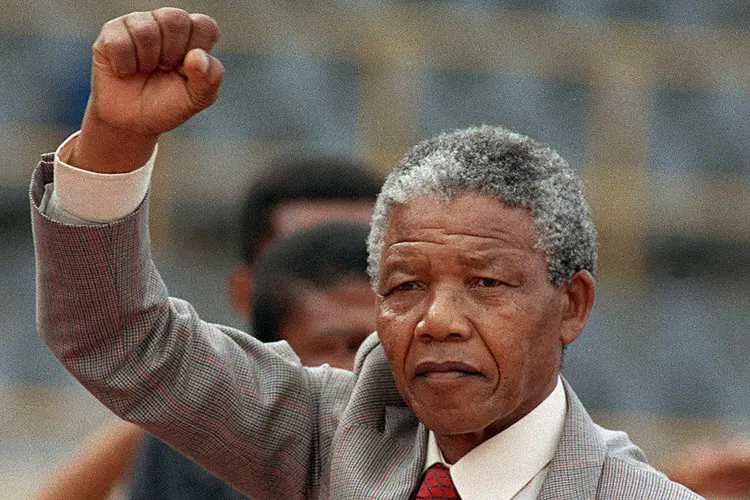
Who Is Nelson Rolihlahla Mandela?
Nelson Rolihlahla Mandela was a South African anti-apartheid activist, lawyer, political leader and philanthropist born on 18 July 1918 in Mvezo, in the Eastern Cape region of South Africa. He became the country’s first democratically elected president, serving from 1994 to 1999, after decades of resistance to apartheid, the system of racial segregation and white minority rule. Mandela spent more than 27 years in prison, shared the 1993 Nobel Peace Prize with former South African president F. W. de Klerk, and became an internationally recognised figure in the transition to democracy. He died in Johannesburg on 5 December 2013, aged 95.
From the Thembu Royal Household to the Anti-Apartheid Struggle
Mandela was born Rolihlahla Mandela into the Madiba clan, connected to the Thembu royal household. His father, Gadla Henry Mphakanyiswa Mandela, served as a counsellor to the Thembu royal family. After his father died when Mandela was young, he became a ward of Thembu regent Jongintaba Dalindyebo and grew up partly at the royal residence in Mqhekezweni.
He attended several schools before studying at the University of Fort Hare. A student protest disrupted his university education, and he later moved to Johannesburg, where he worked and continued studying. He completed a Bachelor of Arts degree through the University of South Africa and studied law at the University of the Witwatersrand.
Mandela joined the African National Congress (ANC) in 1944 and helped establish its Youth League with other young activists. As apartheid laws expanded after the National Party came to power in 1948, he became involved in organised resistance, legal challenges and campaigns against racial discrimination.
His political activities brought repeated arrests and trials. After the ANC was banned in 1960, Mandela became involved in establishing its armed wing, Umkhonto we Sizwe, which carried out sabotage against government infrastructure. He was arrested in 1962 and later sentenced to life imprisonment in the Rivonia Trial in 1964. His imprisonment turned him into a prominent symbol of the international campaign against apartheid. He was released in February 1990, negotiated with the government over a political transition, and became president in May 1994.
Top 10 Defining Facts About Nelson Mandela
1. He Was Born in Mvezo in 1918
Mandela was born on 18 July 1918 in Mvezo, a village in South Africa’s Eastern Cape. His birth name was Rolihlahla, while “Nelson” was given to him by a teacher during his early schooling. His Xhosa name became widely associated with his public identity through the clan name Madiba, which South Africans frequently used when referring to him.
2. He Grew Up Under the Care of a Thembu Regent
Following his father’s death, Mandela was raised under the guardianship of Jongintaba Dalindyebo, the acting regent of the Thembu people. Life at the royal residence exposed him to discussions of leadership, customary authority and the history of African resistance. These early experiences formed part of the background to his later political life.
3. He Helped Found the ANC Youth League in 1944
Mandela joined the ANC in 1944 and helped establish its Youth League alongside figures including Walter Sisulu and Oliver Tambo. The younger activists wanted the organisation to adopt more assertive mass mobilisation against racial discrimination. Mandela later became a leading participant in campaigns challenging apartheid legislation.
4. He Became a Lawyer and Worked With Oliver Tambo
Mandela studied law and became involved in legal practice in Johannesburg. With Oliver Tambo, he helped establish a law practice that served Black South Africans at a time when apartheid restricted their rights and access to institutions. Their work exposed them to the legal consequences of racial discrimination, including restrictions on movement, residence and political participation.
5. He Was Arrested in 1962
Mandela was arrested on 5 August 1962 and initially sentenced to five years in prison for leaving the country without permission and encouraging a workers’ strike. After police raided a secret ANC-linked location at Liliesleaf in 1963, he faced further charges in the Rivonia Trial. In June 1964, he and seven other defendants received life sentences.
6. He Spent More Than 27 Years in Prison
Mandela spent approximately 27 years and six months in prison. He was held at Robben Island for 18 years before being transferred to Pollsmoor Prison and later Victor Verster Prison. His imprisonment became a central issue in international campaigns calling for his release and the dismantling of apartheid.
7. He Was Released on 11 February 1990
Mandela walked free on 11 February 1990, nine days after the government announced the unbanning of the ANC and other prohibited political organisations. His release followed years of domestic resistance, international pressure and discussions within the apartheid government about negotiations. He then took a leading role in talks to establish a democratic political system.
8. He Won the Nobel Peace Prize in 1993
Mandela and F. W. de Klerk jointly received the Nobel Peace Prize in 1993 for their work towards ending apartheid and laying the foundations for a democratic South Africa. The award recognised negotiations between representatives of the apartheid government and the liberation movement during the transition from minority rule.
9. He Became President in 1994
South Africa held its first democratic national election based on universal adult suffrage in April 1994. Mandela voted for the first time in his life and was inaugurated as president on 10 May. His government took office during a period of major political change, with the task of building democratic institutions and addressing the consequences of apartheid. He served one term and stepped down in 1999.
10. He Established Foundations and International Initiatives
After becoming president, Mandela helped establish organisations that continued his public work. The Nelson Mandela Children’s Fund was launched in 1995, and the Nelson Mandela Foundation followed in 1999. The Mandela Rhodes Foundation was established in 2003 to support leadership development in Africa. The United Nations later declared 18 July Nelson Mandela International Day, recognising his contribution to public service and human rights.
Nelson Mandela’s Public Record
Mandela’s public record includes anti-apartheid activism, imprisonment, participation in negotiations, the transition to democratic government and a single presidential term. His political history also includes his involvement in the ANC’s armed struggle, which developed after the banning of the organisation and the failure of earlier forms of resistance to end apartheid. His later work included children’s welfare, education, HIV/AIDS awareness and leadership development. He remains one of the most widely recognised figures in South African and African political history.