Who Is Wangari Maathai?
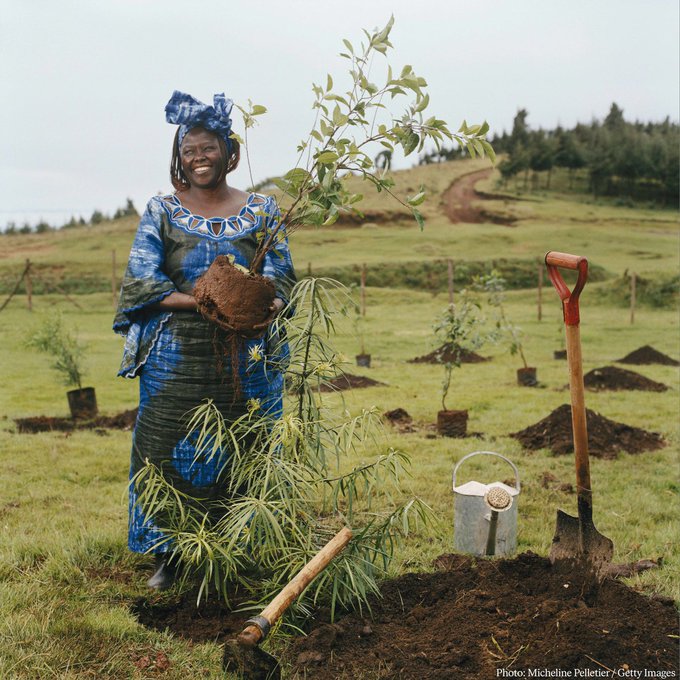
Wangari Muta Maathai (1 April 1940 – 25 September 2011) was a Kenyan environmentalist, biologist, political activist, author and Nobel Peace Prize laureate. Born in Nyeri, Kenya, she founded the Green Belt Movement in 1977, an organisation that mobilised communities, particularly women, to plant trees and protect the environment. In 2004, she became the first African woman to receive the Nobel Peace Prize. She also served as a member of Kenya's Parliament and Assistant Minister for Environment and Natural Resources.
Her Upbringing
Maathai grew up in rural Kenya during British colonial rule. Her family was involved in farming, and she attended schools in Kenya before receiving an opportunity to study in the United States.
In 1964, she graduated from Mount St. Scholastica College in Kansas with a degree in biological sciences. She completed a master's degree at the University of Pittsburgh in 1966.
After further studies in Germany and Kenya, she earned a PhD from the University of Nairobi in 1971, becoming the first woman in East and Central Africa to obtain a doctorate.
She later taught veterinary anatomy at the University of Nairobi, becoming department chair in 1976 and associate professor in 1977.
How Wangari Maathai Built the Green Belt Movement
During her involvement with the National Council of Women of Kenya, Maathai encountered concerns about declining firewood supplies, poor water access and environmental degradation.
She introduced community-based tree planting in 1976 and established the Green Belt Movement in 1977.
The organisation worked with women's groups to establish nurseries, grow seedlings and plant trees on farms, school compounds and other community spaces.
In 1986, the movement established a Pan-African Green Belt Network to share its approach with organisations in other African countries.
Maathai also became involved in political activism, particularly campaigns against land grabbing, environmental destruction and restrictions on democratic rights.
Her activism brought her into conflict with the government of President Daniel arap Moi.
AfricaLists: 10 Remarkable Facts About Wangari Maathai
1. She was the first woman in East and Central Africa to earn a PhD
Maathai completed her doctorate at the University of Nairobi in 1971. Her qualification was in the biological sciences, with research connected to veterinary anatomy. She subsequently held senior academic positions at the university.
2. She founded the Green Belt Movement in 1977
The Green Belt Movement began as a grassroots environmental organisation focused on tree planting and community participation. It organised women's groups to establish nurseries, grow seedlings and restore degraded landscapes.
3. Her movement helped plant tens of millions of trees
The Green Belt Movement has reported planting more than 50 million trees in Kenya since its founding. Earlier reports published during Maathai's lifetime recorded more than 30 million trees. The figures reflect different reporting periods rather than a single fixed total.
4. She challenged plans to build in Nairobi's Uhuru Park
In 1989, Maathai opposed a proposed commercial development in Uhuru Park that included a large office complex.
She publicly challenged the project and faced criticism from government officials. The proposed development was eventually abandoned.
5. She opposed the destruction of Karura Forest
During the 1990s, Maathai campaigned against the allocation of public forest land to private developers.
In January 1999, she and other campaigners encountered violence while protesting developments in Karura Forest, Nairobi.
The forest later became a major public conservation and recreational area.
6. She received the Right Livelihood Award in 1984
Maathai received the Right Livelihood Award in 1984 for her environmental work and efforts to organise communities around reforestation.
The award came two decades before she received the Nobel Peace Prize.
7. She was elected to Kenya's Parliament in 2002
Maathai won the Tetu parliamentary seat during Kenya's December 2002 general election.
She received approximately 98% of the vote and entered Parliament as the country transitioned from Daniel arap Moi's presidency to Mwai Kibaki's administration.
8. She became Assistant Minister for Environment
In January 2003, President Mwai Kibaki appointed Maathai Assistant Minister for Environment and Natural Resources.
She served in Kenya's ninth Parliament and held the assistant ministerial position until 2007.
9. She became the first African woman to win the Nobel Peace Prize
In 2004, Maathai received the Nobel Peace Prize for her contributions to sustainable development, democracy and peace.
She was the first African woman to receive the award and one of the few environmental campaigners recognised by the Nobel Committee for peace-related work.
10. She became a United Nations Messenger of Peace
In December 2009, United Nations Secretary-General Ban Ki-moon appointed Maathai a UN Messenger of Peace, focusing on environmental protection and climate change.
She held the role until her death in Nairobi on 25 September 2011, aged 71.
Wangari Maathai's Books and Public Legacy
Maathai authored several books, including The Green Belt Movement, Unbowed, The Challenge for Africa and Replenishing the Earth.
Her autobiography, Unbowed, was published in 2006 and documented her upbringing, education, environmental activism and political experiences.
The University of Nairobi established the Wangari Maathai Institute for Peace and Environmental Studies, where she was appointed founding distinguished chair in 2010.
Her public record includes the establishment of the Green Belt Movement, decades of environmental campaigning, service in Kenya's Parliament and the 2004 Nobel Peace Prize. The Green Belt Movement continued its activities after her death.