
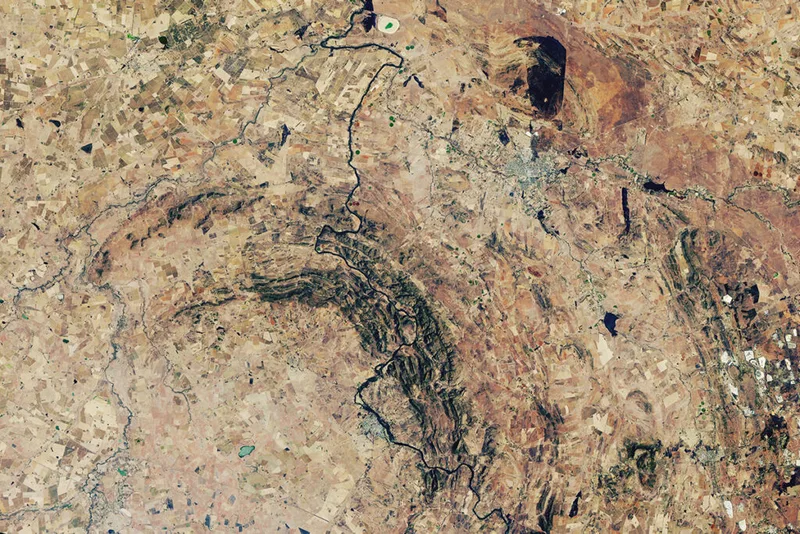
Africa contains some of the oldest and most scientifically important evidence of collisions between Earth and objects from space.
Some impacts created enormous geological structures that remain visible after millions or billions of years. Others left smaller circular craters in deserts, grasslands and rocky landscapes.
Scientists distinguish between an asteroid or meteoroid travelling through space and a meteorite that survives its journey through the atmosphere and reaches the ground. Many ancient impact structures cannot be linked to a particular named asteroid because the original object was destroyed during the collision.
The following list covers 15 scientifically documented African impact structures. The dates and dimensions are approximate because geological estimates vary between studies.
1. Vredefort — South Africa
Estimated age: About 2.02 billion years
Vredefort is one of the most remarkable impact structures on Earth. Located in South Africa's Free State province, it was created by an enormous extraterrestrial collision during the early history of the planet.
The original impact structure is estimated to have been hundreds of kilometers across, although erosion has removed much of its original form.
The surviving Vredefort Dome is recognized as a UNESCO World Heritage Site because of its exceptional geological importance.
2. Bosumtwi — Ghana
Estimated age: About 1.07 million years
Lake Bosumtwi, near Kumasi, occupies a meteorite impact crater approximately 10.5 kilometers across.
The lake is one of West Africa's best-known natural landmarks. Scientists have studied its sediments to understand past environmental conditions, while impact-related material provides evidence of the collision.
Bosumtwi is also culturally significant to communities living around the lake.
3. Roter Kamm — Namibia
Estimated age: About 3.7 million years
Roter Kamm lies in Namibia's Namib Desert.
The crater measures approximately 2.5 kilometers across and is partly filled with sand. Its circular outline remains visible in satellite images.
The surrounding desert has helped preserve the structure, making it an important example of an impact crater in an arid environment.
4. Aorounga — Chad
Estimated age: Uncertain
Aorounga is an impact structure in the Sahara Desert of northern Chad.
It measures approximately 12 kilometers across and features concentric geological formations visible from above.
Its remote location and surrounding desert landscape have made satellite observations particularly valuable for studying its structure.
5. Tenoumer — Mauritania
Estimated age: Approximately 20,000 years
Tenoumer is a circular crater in Mauritania's Sahara Desert, measuring roughly 1.9 kilometers across.
Its relatively young geological age makes it an important example of a well-preserved impact structure.
Scientists have investigated the rocks around the crater to understand the extreme temperatures and pressures generated during impact.
6. Aouelloul — Mauritania
Estimated age: About 3.1 million years
Aouelloul is a small impact crater approximately 390 meters across.
It is located in Mauritania's desert landscape and is associated with impact glass formed when surface material melted during the collision.
Despite its relatively small size, the crater provides useful evidence of extraterrestrial impacts in West Africa.
7. Amguid — Algeria
Estimated age: Not precisely established
Amguid is a circular impact crater in the Algerian Sahara.
It measures approximately 450 meters across and is surrounded by a raised rim.
Its remote desert setting has helped preserve its distinctive appearance.
8. Tin Bider — Algeria
Estimated age: Approximately 70 million years
Tin Bider is a large impact structure in southeastern Algeria.
It measures approximately six kilometers across and contains deformed rock formations associated with a powerful collision.
The structure has undergone substantial geological modification since the impact occurred.
9. Ouarkziz — Algeria
Estimated age: Approximately 70 million years
Ouarkziz is an impact structure in western Algeria, close to the Moroccan border.
Its diameter is approximately 3.5 kilometers. The impact disturbed existing sedimentary rock layers, leaving a geological structure that can still be identified.
10. Talemzane — Algeria
Estimated age: Uncertain
Talemzane, also known as Daïet el Maâder, is a small impact crater in Algeria.
Its diameter is approximately 1.75 kilometers. The crater's circular form and geological evidence distinguish it from ordinary erosion features.
11. Kalkkop — South Africa
Estimated age: Approximately 250,000 years
Kalkkop is a small impact crater in South Africa's Eastern Cape.
It measures roughly 640 meters across and is one of the country's recognized meteorite impact structures.
Its geological characteristics provide evidence of a collision much more recent than the ancient Vredefort event.
12. Tswaing — South Africa
Estimated age: Approximately 220,000 years
Tswaing, historically known as the Pretoria Saltpan crater, lies north of Pretoria.
The crater is approximately 1.1 kilometers across and contains a lake.
Its sediment layers preserve evidence of environmental changes, making Tswaing important for both impact geology and climate research.
13. Oasis — Libya
Estimated age: Uncertain
The Oasis impact structure is located in Libya's southeastern desert.
It measures approximately 18 kilometers across and has been heavily affected by erosion.
Although its original crater form is no longer intact, the geological structure preserves evidence of an ancient collision.
14. B.P. Structure — Libya
Estimated age: Uncertain
The B.P. impact structure is another documented impact feature in Libya.
Its diameter is approximately two kilometers. The structure is located in a remote desert region where geological mapping has helped identify its impact origin.
15. Highbury — Zimbabwe
Estimated age: Uncertain
Highbury is an ancient impact structure in Zimbabwe.
It is considerably less familiar to the public than Vredefort or Bosumtwi, partly because erosion and geological processes have obscured its original appearance.
Its identification contributes to the wider scientific record of impact events across southern Africa.
How These Impact Sites Were Identified
Scientists do not confirm an asteroid impact merely because a landscape contains a circular depression.
Evidence can include shocked quartz, impact-generated glass, unusual rock deformation and other mineral changes produced under extreme pressure.
A 2025 review in the Journal of African Earth Sciences identified 20 confirmed impact structures across Africa at the time of its assessment. This article covers 15 documented examples rather than claiming to list every confirmed structure.
The African impact record also remains incomplete. Erosion, burial and geological activity have erased evidence of many collisions that occurred during the continent's long history.