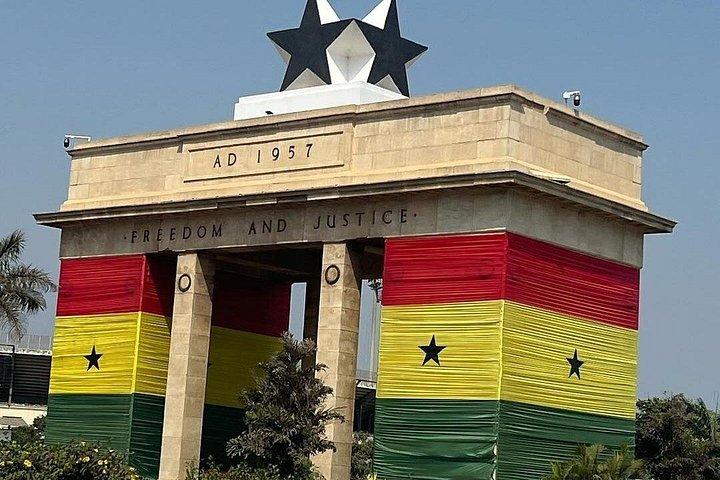
Across Africa, independence brought more than new flags and governments. Several countries also adopted new names, replacing colonial-era territorial labels with names chosen by their new governments. Other countries changed their names years after independence following revolutions, political transitions or decisions to embrace a different national identity.
The changes did not all happen for the same reason. Ghana adopted its name when it became independent in 1957, while Burkina Faso changed its name in 1984. Eswatini's change came much later, in 2018. Historical records document these changes as part of the wider political transformation of African states.
1. Gold Coast to Ghana
Ghana became independent from Britain on March 6, 1957, and adopted the name Ghana instead of Gold Coast.
Gold Coast was the British colonial's name associated with the territory's coastline and historic gold trade. The new name referred to the ancient Ghana Empire, which flourished in West Africa centuries before the modern state existed.
The modern Republic of Ghana is not geographically identical to that historical empire. The name nevertheless connected the newly independent country to an earlier period of African political history.
Ghana's independence under Kwame Nkrumah became a landmark in the African decolonization movement, and the name change was part of that transition.
2. Northern Rhodesia to Zambia
Zambia became independent on October 24, 1964. Before independence, the territory was known as Northern Rhodesia under British colonial administration.
The new name was derived from the Zambezi River, which flows along part of Zambia's southern border before continuing towards Mozambique and the Indian Ocean.
The independence-era name distinguished the country from Southern Rhodesia, the territory that later became Zimbabwe. Zambia's first president was Kenneth Kaunda, who led the country after independence.
The renaming marked the creation of a sovereign state rather than a continuation of the colonial territory's official designation.
3. Nyasaland to Malawi
Malawi became independent from Britain on July 6, 1964, replacing the colonial name Nyasaland.
The name Malawi has historical and geographical associations with the region and its people. Lake Malawi, one of Africa's largest lakes, occupies a substantial part of the country's eastern boundary.
The country became a republic in 1966 under President Hastings Kamuzu Banda. The transition from Nyasaland to Malawi formed part of the process through which the former British territory established its own national identity.
The country continues to be officially known as the Republic of Malawi.
4. Bechuanaland to Botswana
Botswana gained independence on September 30, 1966, after being administered by Britain as the Bechuanaland Protectorate.
The name Botswana is associated with the Tswana people, while the country's citizens are known as Batswana. Its adoption reflected the transition from a colonial protectorate to an independent state.
At independence, Seretse Khama became the country's first president. Botswana later developed a political record marked by regular elections and civilian government.
The change also removed the colonial territorial label from the country's official identity.
5. Basutoland to Lesotho
Lesotho became independent on October 4, 1966, replacing the colonial name Basutoland.
The country is a mountainous kingdom entirely surrounded by South Africa. Its name is linked to the Basotho people, whose history and language remain central to the country's national identity.
Lesotho retained its monarchy after independence, with a constitutional system that has undergone several political changes over the decades.
The change from Basutoland to Lesotho established the name used by the sovereign kingdom today.
6. French Sudan to Mali
Mali gained independence in 1960 following the dissolution of the short-lived Mali Federation, which had initially united Mali and Senegal.
The territory had been known as French Sudan under French colonial rule. The name Mali refers to the historic Mali Empire, a major West African state associated with rulers such as Mansa Musa and the historic city of Timbuktu.
The modern Republic of Mali is distinct from the medieval empire, but the shared name establishes a connection to the region's earlier history.
The change replaced a colonial administrative name with one rooted in African history.
7. Dahomey to Benin
The country now known as Benin became independent from France in 1960 as the Republic of Dahomey. In 1975, the government adopted the name People's Republic of Benin.
The name Benin was drawn from the wider historical and geographical region around the Bight of Benin. It avoided making the entire country appear to belong to the legacy of the historic Kingdom of Dahomey, which had been centered in the south.
The country later dropped the word "People's" from its official name following political changes in 1990. Today it is the Republic of Benin.
8. Upper Volta to Burkina Faso
Upper Volta became independent from France in 1960. On August 4, 1984, President Thomas Sankara's government renamed the country Burkina Faso.
The previous name referred to the Volta River system. Burkina Faso instead drew on local languages, with the name commonly translated as "Land of Upright People" or "Land of Honest People."
The change formed part of Sankara's wider political programme, which emphasized national independence and a break with colonial-era conventions.
The country retained the name Burkina Faso after subsequent changes of government.
9. Zaire to the Democratic Republic of the Congo
The country now called the Democratic Republic of the Congo gained independence from Belgium in 1960. It was initially known as the Republic of the Congo, then adopted the name Democratic Republic of the Congo in 1964.
President Mobutu Sese Seko renamed it Zaire in 1971 as part of a national campaign known as Authenticité, which promoted African names and cultural identity.
After Mobutu's government fell in 1997, the country returned to the name Democratic Republic of the Congo.
This is one of the clearest examples of a country's official name changing several times in response to different political eras.
10. Swaziland to Eswatini
The Kingdom of Swaziland changed its official name to the Kingdom of Eswatini in April 2018. King Mswati III announced the change during celebrations marking the country's 50th anniversary of independence.
Eswatini is the name used for the country in the Swazi language and is commonly translated as "land of the Swazis."
Unlike countries that changed their names at independence, Swaziland had operated under that name for decades before the 2018 announcement.
The change was intended to align the country's international name with its local-language identity and reduce confusion with Switzerland, another country whose English name sounds similar.
Methodology
The list includes ten African countries whose official names changed at independence or during a later political transition. The entries are arranged by historical sequence rather than by popularity or significance. The dates distinguish independence from subsequent renaming, particularly for Benin, Burkina Faso and the Democratic Republic of the Congo.